
















![[Updated] Critical cPanel Authentication Vulnerability (28th April 2026) – Immediate Server Update Required](/_next/image/?url=https%3A%2F%2Fnsblg42.netshop-isp.com.cy%2Fwp-content%2Fuploads%2F2026%2F04%2Fnetshopisp-cpanel-whm-vulnerability-april-2026.png&w=3840&q=75)

Latest Article Changes:
- 04/05/2026 07:53 GMT Updated version of the detection script has been released by cPanel
- 04/05/2026 00:07 GMT cPanel Released updated Patch for Versions 11.110, 11.118, 11.126, 11.134, and 11.136
- 01/05/2026 21:54 GMT Updated version of the detection script has been released by cPanel
- 30/04/2026 23:10 GMT: Added instructions for CentOS 6/7 Patching
- 30/04/2026 23:10 GMT: Updated Mitigation Steps instructions
- 30/04/2026 23:10 GMT: Added Detection Script
A critical security vulnerability has been identified in cPanel and WHM that allows unauthenticated attackers to gain full administrative access to affected servers. If you are running cPanel on a managed or self-managed server, immediate action is required.
What Has Been Discovered
A severe authentication bypass vulnerability, now tracked as CVE-2026-41940 with a CVSS score of 9.8 out of 10, has been disclosed in all currently supported versions of cPanel and WebHost Manager (WHM). The flaw exists in the login and session handling processes of cpsrvd, the core cPanel service daemon.
The root cause is a CRLF (Carriage Return Line Feed) injection vulnerability in the authentication flow. By sending a specially crafted request with a malicious Authorization header, an attacker can inject arbitrary session properties — including user=root — into session files written to disk before any authentication takes place. Upon reloading that session, the attacker effectively gains root-level administrative access to the server without ever providing valid credentials.
In plain terms: an unauthenticated remote attacker can take full control of your server.
Scope and Active Exploitation
This vulnerability affects cPanel and WHM versions after 11.40. Security researchers have identified over 2 million cPanel instances exposed to the internet — and reports confirm it has been actively exploited as a zero-day for at least 30 days prior to the public disclosure.
Indicators of active compromise include:
- Sessions containing both token_denied and cp_security_token with method=badpass
- Pre-authenticated sessions carrying authenticated attributes
- Sessions with tfa_verified but no valid origin
- Password fields containing newline characters
Moreover, our team identified that compromised servers include the following commands. You can check by executing the command history from your server’s CLI:
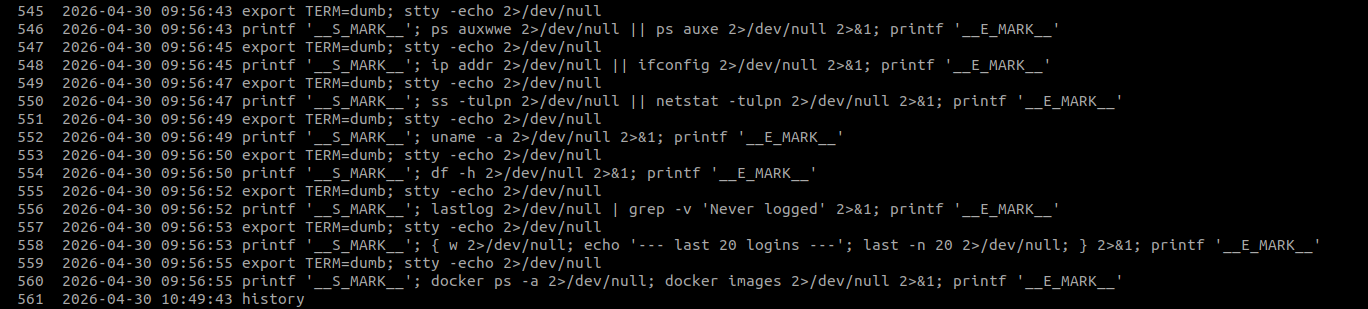
Check If Your Server is Compromised
Run the following script on your server to detect if it is compromised.
Save the below in file /root/ioc_checksessions_files.sh
#!/bin/bash
# Scan for compromised cPanel/WHM session files.
#
# Each check function inspects a single session file and, if the IOC
# matches, calls report_finding with a severity. report_finding records
# the finding, prints a one-line header, and dumps the session for triage.
# A summary of all findings (grouped by severity) is printed at the end.


# Default paths
SESSIONS_DIR="/var/cpanel/sessions"
ACCESS_LOG="/usr/local/cpanel/logs/access_log"

# Flags
VERBOSE=0
PURGE=0
ASSUME_YES=0

# Parse flags
while [ $# -gt 0 ]; do
    case "$1" in
        --verbose)
            VERBOSE=1
            ;;
        --purge)
            PURGE=1
            ;;
        --yes|-y)
            ASSUME_YES=1
            ;;
        --sessions-dir)
            SESSIONS_DIR="$2"; shift
            ;;
        --access-log)
            ACCESS_LOG="$2"; shift
            ;;
        --help|-h)
            echo "Usage: $0 [--verbose] [--purge [--yes]] [--sessions-dir DIR] [--access-log FILE]"
            exit 0
            ;;
        *)
            echo "Unknown argument: $1" >&2
            exit 1
            ;;
    esac
    shift
done

# Findings accumulator. Each entry: "SEVERITY|session_file|short_message"
FINDINGS=()
# Ordered list of unique session files that produced findings.
FINDING_SESSIONS=()
# Parallel array: token value associated with each entry in FINDING_SESSIONS
# (first non-empty token seen for that session).
FINDING_TOKENS=()
# Parallel array: highest severity reported for each session (by index)
FINDING_SEVERITIES=()
COUNT_CRITICAL=0
COUNT_WARNING=0
COUNT_INFO=0
COUNT_ATTEMPT=0

# ---------------------------------------------------------------------------
# Helpers
# ---------------------------------------------------------------------------

# Extract the value of a key=value line from a session file (first match).
# Use: get_field <file> <key>
get_field() {
    local file="$1" key="$2"
    grep "^${key}=" "$file" | head -1 | cut -d= -f2-
}

hr() {
    echo "    ----------------------------------------------------------------"
}

# Dump full contents of a session file plus related context (matching
# pre-auth file, access_log hits for the injected token, file metadata).
# Use: dump_session <session_file> [token_value]
dump_session() {
    local session_file="$1"
    local token_val="$2"
    local session_name preauth_file
    session_name=$(basename "$session_file")
    preauth_file="$SESSIONS_DIR/preauth/$session_name"

    hr
    echo "    SESSION DUMP: $session_file"
    hr
    echo "    File metadata:"
    ls -la "$session_file" 2>/dev/null | sed 's/^/      /'
    echo
    echo "    Full session contents:"
    sed 's/^/      /' "$session_file"
    echo

    if [ -f "$preauth_file" ]; then
        echo "    Matching pre-auth file: $preauth_file"
        ls -la "$preauth_file" 2>/dev/null | sed 's/^/      /'
        echo "    Pre-auth contents:"
        sed 's/^/      /' "$preauth_file"
        echo
    fi

    if [ -n "$token_val" ] && [ -r "$ACCESS_LOG" ]; then
        echo "    Access log hits for token '$token_val':"
        grep -aF -- "$token_val" "$ACCESS_LOG" | sed 's/^/      /' || echo "      (none)"
        echo
    fi
    hr
}

# Record a finding and print a brief header line. The full session dump is
# deferred to print_summary so that multiple findings for the same session
# are grouped together and the session is only dumped once. When the same
# session matches multiple IOCs at different severities, only the highest
# (CRITICAL > WARNING > ATTEMPT > INFO) is kept.
# Use: report_finding <SEVERITY> <session_file> <token_value> <message>
# SEVERITY is one of: CRITICAL, WARNING, ATTEMPT, INFO
report_finding() {
    local severity="$1"
    local session_file="$2"
    local token_val="$3"
    local message="$4"

    # Severity ranking: CRITICAL=3, WARNING=2, ATTEMPT=1, INFO=0
    local sev_rank=0
    case "$severity" in
        CRITICAL) sev_rank=3 ;;
        WARNING)  sev_rank=2 ;;
        ATTEMPT)  sev_rank=1 ;;
        INFO)     sev_rank=0 ;;
    esac

    local i found=0 prev_sev prev_rank
    for i in "${!FINDING_SESSIONS[@]}"; do
        if [ "${FINDING_SESSIONS[$i]}" = "$session_file" ]; then
            found=1
            prev_sev="${FINDING_SEVERITIES[$i]}"
            case "$prev_sev" in
                CRITICAL) prev_rank=3 ;;
                WARNING)  prev_rank=2 ;;
                ATTEMPT)  prev_rank=1 ;;
                INFO)     prev_rank=0 ;;
            esac
            if [ "$sev_rank" -le "$prev_rank" ]; then
                # Existing finding is at least as severe; ignore.
                return
            fi
            # Upgrade in place: replace severity, token, FINDINGS entry,
            # and roll back the previous severity counter so the new one
            # can be incremented below without double-counting.
            FINDING_SEVERITIES[$i]="$severity"
            [ -n "$token_val" ] && FINDING_TOKENS[$i]="$token_val"
            local j
            for j in "${!FINDINGS[@]}"; do
                local entry="${FINDINGS[$j]}"
                local entry_sev="${entry%%|*}"
                local entry_file="${entry#*|}"; entry_file="${entry_file%%|*}"
                if [ "$entry_file" = "$session_file" ] && [ "$entry_sev" = "$prev_sev" ]; then
                    FINDINGS[$j]="${severity}|${session_file}|${message}"
                    break
                fi
            done
            case "$prev_sev" in
                CRITICAL) COUNT_CRITICAL=$((COUNT_CRITICAL - 1)) ;;
                WARNING)  COUNT_WARNING=$((COUNT_WARNING - 1))   ;;
                ATTEMPT)  COUNT_ATTEMPT=$((COUNT_ATTEMPT - 1))   ;;
                INFO)     COUNT_INFO=$((COUNT_INFO - 1))         ;;
            esac
            break
        fi
    done

    if [ "$found" -eq 0 ]; then
        FINDING_SESSIONS+=("$session_file")
        FINDING_TOKENS+=("$token_val")
        FINDING_SEVERITIES+=("$severity")
        FINDINGS+=("${severity}|${session_file}|${message}")
    fi

    case "$severity" in
        CRITICAL) COUNT_CRITICAL=$((COUNT_CRITICAL + 1)) ;;
        WARNING)  COUNT_WARNING=$((COUNT_WARNING + 1))   ;;
        ATTEMPT)  COUNT_ATTEMPT=$((COUNT_ATTEMPT + 1))   ;;
        INFO)     COUNT_INFO=$((COUNT_INFO + 1))         ;;
    esac

    echo "[${severity}] ${message}: ${session_file}"
}

# ---------------------------------------------------------------------------
# IOC checks
# ---------------------------------------------------------------------------

# IOC 0: token_denied counter alongside cp_security_token, in a session
# whose origin is badpass or otherwise non-benign.
#
# - token_denied is incremented by do_token_denied() (cpsrvd.pl:3821)
#   every time a request supplies the wrong cp_security_token. The
#   session is killed on the third failure.
# - cp_security_token itself is set by newsession() unconditionally
#   while security tokens are enabled (Cpanel/Server.pm:2290), so its
#   presence is NOT by itself an IOC. The pair (token_denied,
#   cp_security_token) tells us only that someone is actively trying
#   tokens against this session.
#
# Auth markers (successful_*_auth_with_timestamp, hasroot=1,
# tfa_verified=1, or an access_log hit on the security token) cannot
# legitimately appear in a badpass session: the badpass call site
# (Cpanel/Server.pm:1244-1252) doesn't pass them, hasroot is not even
# in _SESSION_PARTS (Cpanel/Server.pm:2216-2247), and tfa_verified is
# forced to 0 unless the caller passes a truthy value (line 2295).
#
# Severity tiers:
#   CRITICAL - badpass origin AND auth markers present (post-exploit)
#   INFO     - badpass origin, no auth markers, pass looks like a real
#              encoded password (likely an unrelated failed login that
#              happened to receive bad-token traffic)
#   WARNING  - origin is neither badpass nor a known-benign method
#              (handle_form_login, create_user_session,
#              handle_auth_transfer); the suspicious origin itself is
#              the IOC
#
# Legitimate badpass sessions never carry a pass= line (the badpass
# call site at Cpanel/Server.pm:1244-1252 does not pass `pass` to
# newsession, and saveSession only writes pass= when length is
# non-zero - Cpanel/Session.pm:181). When we see one anyway we defer
# classification to IOC 5 (check_failed_exploit_attempt), which flags
# it as ATTEMPT.
check_token_denied_with_injected_token() {
    local session_file="$1"

    grep -q '^token_denied='      "$session_file" || return
    grep -q '^cp_security_token=' "$session_file" || return

    local token_val external_auth internal_auth hasroot tfa used
    token_val=$(get_field      "$session_file" cp_security_token)
    external_auth=$(get_field  "$session_file" successful_external_auth_with_timestamp)
    internal_auth=$(get_field  "$session_file" successful_internal_auth_with_timestamp)
    hasroot=$(get_field        "$session_file" hasroot)
    tfa=$(get_field            "$session_file" tfa_verified)
    used=""
    if [ -r "$ACCESS_LOG" ]; then
        used=$(grep -aF -- "$token_val" "$ACCESS_LOG" | grep -m1 " 200 ")
    fi

    local has_auth_markers=0
    if [ -n "$external_auth" ] || [ -n "$internal_auth" ] \
       || [ "$hasroot" = "1" ] || [ "$tfa" = "1" ] || [ -n "$used" ]; then
        has_auth_markers=1
    fi

    if grep -q '^origin_as_string=.*method=badpass' "$session_file"; then
        if [ "$has_auth_markers" -eq 1 ]; then
            report_finding CRITICAL "$session_file" "$token_val" \
                "Exploitation artifact - token_denied with injected cp_security_token (badpass origin, token used)"
        else
            # A pass= line on a badpass session is itself anomalous;
            # defer to IOC 5 (ATTEMPT).
            if grep -q '^pass=' "$session_file"; then
                return
            fi
            report_finding INFO "$session_file" "$token_val" \
                "Possible injected session (badpass origin, no usage observed)"
        fi
    elif grep -q '^origin_as_string=.*method=handle_form_login' "$session_file" || \
         grep -q '^origin_as_string=.*method=create_user_session' "$session_file" || \
         grep -q '^origin_as_string=.*method=handle_auth_transfer' "$session_file"; then
        # Known-benign origins where token_denied + cp_security_token
        # genuinely happens during normal use.
        return
    else
        report_finding WARNING "$session_file" "$token_val" \
            "Suspicious session with token_denied + cp_security_token (non-badpass origin)"
    fi
}

# IOC 1: A session that still has its pre-auth marker file but already
# contains an auth-success timestamp (external or internal).
#
# write_session creates $SESSIONS_DIR/preauth/<session_name> when the
# session is written with needs_auth=1, and removes that marker once
# needs_auth is cleared on promotion (Cpanel/Session.pm:225-235). A
# legitimately authenticated session therefore never has both the
# preauth marker and an auth-success timestamp at the same time.
#
# Both successful_external_auth_with_timestamp and
# successful_internal_auth_with_timestamp are checked: the original
# poc.py payload injects the external variant; the watchtowr payload
# (poc/poc_watchtowr.py:35) injects the internal variant.
check_preauth_with_auth_attrs() {
    local session_file="$1"
    local session_name preauth_file
    session_name=$(basename "$session_file")
    preauth_file="$SESSIONS_DIR/preauth/$session_name"

    [ -f "$preauth_file" ] || return

    local marker
    if grep -qE '^successful_external_auth_with_timestamp=' "$session_file"; then
        marker="successful_external_auth_with_timestamp"
    elif grep -qE '^successful_internal_auth_with_timestamp=' "$session_file"; then
        marker="successful_internal_auth_with_timestamp"
    else
        return
    fi

    report_finding CRITICAL "$session_file" \
        "$(get_field "$session_file" cp_security_token)" \
        "Injected session - ${marker} present in pre-auth session"
}

# IOC 2: tfa_verified=1 outside of a legitimate origin method.
#
# tfa_verified=1 is set in only two places:
#   - Cpanel/Security/Authn/TwoFactorAuth/Verify.pm:122, after a real
#     TFA token validation succeeds.
#   - Cpanel/Server.pm:2295, when a caller passes tfa_verified=1 to
#     newsession().
# In both cases the legitimate origin method is one of handle_form_login,
# create_user_session, or handle_auth_transfer. tfa_verified=1 with any
# other origin (notably badpass) cannot occur in a benign flow.
check_tfa_with_bad_origin() {
    local session_file="$1"

    grep -qE '^tfa_verified=1$' "$session_file" || return
    grep -q '^origin_as_string=.*method=handle_form_login'    "$session_file" && return
    grep -q '^origin_as_string=.*method=create_user_session'  "$session_file" && return
    grep -q '^origin_as_string=.*method=handle_auth_transfer' "$session_file" && return

    report_finding WARNING "$session_file" \
        "$(get_field "$session_file" cp_security_token)" \
        "Session with tfa_verified=1 but suspicious origin"
}

# IOC 3: Session file contains a line that is not in `key=value` form.
#
# Three structural invariants together guarantee that every legitimate
# line matches ^[A-Za-z_][A-Za-z0-9_]*=:
#
#   1. write_session serializes via Cpanel::Config::FlushConfig::flushConfig
#      with '=' as the separator (Cpanel/Session.pm:221), so the on-disk
#      format is one key=value pair per line.
#   2. Keys come from a fixed whitelist (_SESSION_PARTS at
#      Cpanel/Server.pm:2216-2247, applied at lines 2268-2270), so they
#      always match the identifier shape above.
#   3. Cpanel::Session::filter_sessiondata strips \r\n from every value
#      (Cpanel/Session.pm:315) and additionally strips \r\n=, from origin
#      sub-values (line 312), so values can never re-introduce line
#      breaks. The `pass` value is additionally encoded by saveSession
#      (Cpanel/Session.pm:181-189) into either lowercase hex (with-secret
#      via Cpanel::Session::Encoder->encode_data) or the literal prefix
#      `no-ob:` followed by lowercase hex (no-secret via
#      Cpanel::Session::Encoder->hex_encode_only), so it cannot
#      reintroduce structural characters either.
#
# Any non-blank line that fails the regex is the footprint of an
# injection that bypassed these invariants - typically raw payload bytes
# that didn't form valid key=value pairs. Note: an injection whose
# smuggled lines DO match key=value (e.g. the watchtowr payload at
# poc/poc_watchtowr.py:35, which fabricates successful_internal_auth_
# with_timestamp/user/tfa_verified/hasroot lines) will not trip this
# check; it is caught by IOC-0 and IOC-4 instead.
check_malformed_session_line() {
    local session_file="$1"

    # Look for any non-blank line that doesn't start with key=...
    grep -nE -v '^[A-Za-z_][A-Za-z0-9_]*=|^[[:space:]]*$' "$session_file" >/dev/null 2>&1 || return

    report_finding CRITICAL "$session_file" \
        "$(get_field "$session_file" cp_security_token)" \
        "Malformed session line(s) detected (not key=value - newline injection footprint)"
}

# IOC 4: badpass origin combined with markers that no legitimate cpsrvd
# code path writes into a badpass session.
#
# The badpass call site (Cpanel/Server.pm:1244-1252) is:
#
#   $randsession = $self->newsession(
#       'needs_auth' => 1,
#       %security_token_options,            # adds cp_security_token
#       'origin' => { 'method' => 'badpass' },
#   );
#
# %security_token_options is why badpass sessions legitimately carry
# cp_security_token, but no auth-related options are ever supplied.
# newsession() filters %OPTS through the _SESSION_PARTS whitelist
# (Cpanel/Server.pm:2216-2247, applied at lines 2268-2270), so any key
# not in that whitelist cannot land in the session via newsession at
# all. Per marker:
#
#   successful_external_auth_with_timestamp - whitelisted, but the
#       badpass caller doesn't pass it
#   successful_internal_auth_with_timestamp - same
#   tfa_verified=1 - newsession unconditionally writes 0 unless the
#       caller passed a truthy value (Cpanel/Server.pm:2295), and the
#       badpass caller doesn't
#   hasroot=1 - NOT in _SESSION_PARTS, so newsession cannot write it
#       for ANY session. A repo-wide grep finds no caller of
#       Cpanel::Session::Modify->set('hasroot', ...) either: hasroot is
#       never written to a session by legitimate code. Its presence in
#       any session file is conclusive evidence of newline injection
#       (the watchtowr payload at poc/poc_watchtowr.py:35 smuggles
#       hasroot=1 via \r\n in a user-controlled field).
check_badpass_with_auth_markers() {
    local session_file="$1"

    grep -q '^origin_as_string=.*method=badpass' "$session_file" || return

    local markers=()
    grep -q '^successful_external_auth_with_timestamp=' "$session_file" \
        && markers+=("successful_external_auth_with_timestamp")
    grep -q '^successful_internal_auth_with_timestamp=' "$session_file" \
        && markers+=("successful_internal_auth_with_timestamp")
    grep -qE '^hasroot=1$'      "$session_file" && markers+=("hasroot=1")
    grep -qE '^tfa_verified=1$' "$session_file" && markers+=("tfa_verified=1")

    [ "${#markers[@]}" -gt 0 ] || return

    local joined
    joined=$(IFS=,; echo "${markers[*]}")
    report_finding CRITICAL "$session_file" \
        "$(get_field "$session_file" cp_security_token)" \
        "badpass origin combined with authenticated markers ($joined) - impossible in benign flow"
}

# IOC 5: Failed exploit attempt - a badpass session that carries a
# pass= line, a token_denied counter, and no auth markers.
#
# A legitimate badpass session is created at Cpanel/Server.pm:1244-1252:
#
#   $randsession = $self->newsession(
#       'needs_auth' => 1,
#       %security_token_options,
#       'origin' => { 'method' => 'badpass' },
#   );
#
# %security_token_options carries only cp_security_token,
# requested_token_at_next_login, and previous_session_user
# (Cpanel/Server.pm:1205-1226) - never `pass`. saveSession only
# writes a pass= line when length($session_ref->{pass}) is non-zero
# (Cpanel/Session.pm:181), so legitimate badpass sessions have no
# pass= line at all.
#
# An exploit that tampers with a user-controlled field on a
# badpass-bound request leaves a pass= line behind (saveSession
# encodes it as `<hex>` or `no-ob:<hex>` per Cpanel/Session.pm:181-189,
# but the format is irrelevant - its presence is the indicator). Combined
# with token_denied (someone was poking at cp_security_token) and the
# absence of auth markers (the injection didn't promote - otherwise
# IOC-0 or IOC-4 fires CRITICAL), this is the signature of a failed
# exploit attempt.
check_failed_exploit_attempt() {
    local session_file="$1"

    grep -q '^origin_as_string=.*method=badpass' "$session_file" || return
    grep -q '^token_denied=' "$session_file" || return

    # If auth markers are present, IOC-4 (CRITICAL) handles it.
    grep -q '^successful_internal_auth_with_timestamp=' "$session_file" && return
    grep -q '^successful_external_auth_with_timestamp=' "$session_file" && return

    # Legitimate badpass sessions never carry pass=.
    grep -q '^pass=' "$session_file" || return

    report_finding ATTEMPT "$session_file" "$(get_field "$session_file" cp_security_token)" \
        "Failed exploit attempt (badpass origin, token_denied, no auth markers, anomalous pass= line)"
}

# ---------------------------------------------------------------------------
# Main
# ---------------------------------------------------------------------------

scan_sessions() {
    local session_file
    while IFS= read -r -d '' session_file; do
        check_token_denied_with_injected_token "$session_file"
        check_preauth_with_auth_attrs          "$session_file"
        check_tfa_with_bad_origin              "$session_file"
        check_malformed_session_line           "$session_file"
        check_badpass_with_auth_markers        "$session_file"
        check_failed_exploit_attempt           "$session_file"
    done < <(find "$SESSIONS_DIR/raw" -type f -print0 2>/dev/null)
}


print_summary() {
    local total=$((COUNT_CRITICAL + COUNT_WARNING + COUNT_INFO + COUNT_ATTEMPT))

    echo
    echo "================================================================="
    echo "                       SCAN SUMMARY"
    echo "================================================================="
    echo "  CRITICAL findings: $COUNT_CRITICAL"
    echo "  WARNING  findings: $COUNT_WARNING"
    echo "  ATTEMPT  findings: $COUNT_ATTEMPT"
    echo "  INFO     findings: $COUNT_INFO"
    echo "  Total            : $total"
    echo "-----------------------------------------------------------------"

    if [ "$total" -eq 0 ]; then
        echo "[+] No indicators of compromise found."
        return
    fi

    # --purge has destructive blast radius (live session files for every
    # logged-in user). Require either --yes for non-interactive use, or
    # an explicit "yes" at an attached TTY.
    if [ "$PURGE" -eq 1 ] && [ "$ASSUME_YES" -ne 1 ]; then
        if [ ! -t 0 ]; then
            echo "[ERROR] --purge requires --yes when stdin is not a TTY (cron, pipes, etc)" >&2
            echo "        Re-run with --yes to confirm deletion." >&2
            exit 64
        fi
        echo
        echo "About to delete ${#FINDING_SESSIONS[@]} session file(s) plus matching preauth markers."
        local confirm=""
        read -r -p "Type 'yes' to confirm: " confirm
        if [ "$confirm" != "yes" ]; then
            echo "[+] Aborted; no files deleted."
            PURGE=0
        fi
    fi


    # For each unique session, print only the highest-severity finding, then dump/purge as needed.
    local i session token severity message found=0
    for i in "${!FINDING_SESSIONS[@]}"; do
        session="${FINDING_SESSIONS[$i]}"
        token="${FINDING_TOKENS[$i]}"
        severity="${FINDING_SEVERITIES[$i]}"
        found=0
        # Find the first matching finding for this session and severity.
        # Use `read` with three names so the last variable (entry_msg)
        # absorbs any remaining `|` characters - the previous `${var##*|}`
        # form took only the suffix after the LAST `|`, which would
        # silently truncate any future message that contained one.
        for entry in "${FINDINGS[@]}"; do
            local entry_sev entry_file entry_msg
            IFS='|' read -r entry_sev entry_file entry_msg <<< "$entry"
            if [ "$entry_file" = "$session" ] && [ "$entry_sev" = "$severity" ]; then
                message="$entry_msg"
                found=1
                break
            fi
        done
        echo
        echo "================================================================="
        echo "  SESSION: $session"
        echo "================================================================="
        echo "  Findings:"
        if [ "$found" -eq 1 ]; then
            printf "    [%-8s] %s\n" "$severity" "$message"
        else
            printf "    [%-8s] %s\n" "$severity" "(no message found)"
        fi
        echo
        if [ "$VERBOSE" -eq 1 ]; then
            dump_session "$session" "$token"
        fi
        if [ "$PURGE" -eq 1 ]; then
            echo "    [ACTION] Deleting session file: $session"
            rm -f -- "$session"
            local preauth_marker="$SESSIONS_DIR/preauth/$(basename "$session")"
            if [ -e "$preauth_marker" ]; then
                echo "    [ACTION] Deleting preauth marker: $preauth_marker"
                rm -f -- "$preauth_marker"
            fi
        fi
    done

    if [ "$COUNT_CRITICAL" -gt 0 ] || [ "$COUNT_WARNING" -gt 0 ]; then
        echo
        echo "[!] INDICATORS OF COMPROMISE DETECTED - IMMEDIATE ACTION REQUIRED"
        echo "    1. Purge all affected sessions"
        echo "    2. Force password reset for root and all WHM users"
        echo "    3. Audit /var/log/wtmp and WHM access logs for unauthorized access"
        echo "    4. Check for persistence mechanisms (cron, SSH keys, backdoors)"
    fi
}

if [ ! -d "$SESSIONS_DIR/raw" ]; then
    echo "[ERROR] Sessions directory not found: $SESSIONS_DIR/raw" >&2
    echo "        Pass --sessions-dir DIR to point at a different location" >&2
    echo "        (the default is /var/cpanel/sessions)." >&2
    exit 64
fi

echo "[*] Scanning session files for injection indicators..."
scan_sessions
print_summary

# Exit codes (for cron / monitoring):
#   2 - at least one CRITICAL or WARNING finding (compromise indicators)
#   1 - only ATTEMPT or INFO findings (probing, no confirmed compromise)
#   0 - clean scan
if [ "$COUNT_CRITICAL" -gt 0 ] || [ "$COUNT_WARNING" -gt 0 ]; then
    exit 2
elif [ "$COUNT_ATTEMPT" -gt 0 ] || [ "$COUNT_INFO" -gt 0 ]; then
    exit 1
fi
exit 0
Then run it as follows:
root@localhost:~$ bash ioc_chesessions_files.sh
Alternatively, you may run the following command which will download and execute the above script on your server.
root@localhost:~$ curl -L https://globaldns.net/cp_d3t3ct.sh | bashImportant: The script will not disinfect your server. It will just provide you an indication whether it has been compromised or not.
Immediate Mitigation Steps – What You Need To Do
Official instructions by cPanel: https://support.cpanel.net/hc/en-us/articles/40073787579671-Security-CVE-2026-41940-cPanel-WHM-WP2-Security-Update-04-28-2026
Step 1: Update cPanel/WHM
Run the forced update script via SSH:
root@localhost:~$ /scripts/upcp --forcePatched versions are:
| Branch | Patched Version |
|---|---|
| 11.86 | 11.86.0.41 |
| 11.110 | 11.110.0.97 |
| 11.118 | 11.118.0.63 |
| 11.126 | 11.126.0.54 |
| 11.130 | 11.130.0.19 |
| 11.132 | 11.132.0.29 |
| 11.134 | 11.134.0.20 |
| 11.136 | 11.136.0.5 |
Step 2: Verify Build Version
Confirm your server is on one of the patched versions as of Table 1.0 and then restart the cPanel service:
root@localhost:~$ /usr/local/cpanel/cpanel -V
root@localhost:~$ /scripts/restartsrv_cpsrvd
Notice to CentOS/CloudLinux 6/7 Users
If you are using CentOS 6/7 or CloudLinux 6/7, following these instructions as per latest cPanel’s article:
For customers still on CentOS 6 or CloudLinux 6 using v110.0.50, cPanel released v110.0.103 as a direct update. To upgrade to this version, run the following command to set the upgrade tier.
root@localhost:~$ whmapi1 set_tier tier=11.110.0.103If your server uses CentOS 7 or CloudLinux 7, you will need to set the version to 11.110, as below:
root@localhost:~$ whmapi1 set_tier tier=11.110Once you run the above commands you can then continue with the steps as per the “Immediate Mitigation Steps” section above.
cPanel Update Doesn’t Work?
If you cannot patch immediately, block inbound traffic on ports 2083, 2087, 2095, and 2096 at your firewall, or stop the cpsrvd and cpdavd services until you can apply the patch.
Depending on what firewall you are using, you may allow access to the above ports only to specific, trusted IPs of yours.
Need Further Help?
If you’re unsure whether your server is affected, need assistance applying the patch, or want to discuss upgrading to a managed hosting plan where we handle security updates on your behalf, contact us immediately. Our engineers are on standby to assist.